Last Updated: November 15, 2026
Quick Summary
Hollywood aviation is built for spectacle, not accuracy, because films need conflict and resolution in roughly two hours while real aviation is hours of checklists, radio calls, and quiet monitoring. That trade-off explains the impossible stowaways, unrealistic cockpits, and dramatic engine failures you see on screen.
- A person in a landing gear bay would lose consciousness within minutes from hypoxia and cold.
- Real turbulence is often brief, and crews secure the cabin and ride it out.
- A modern airliner can fly on one engine, and crews rehearse the procedure until automatic.
- Real radio calls are short, standardized, and read back for confirmation.
- Real squadrons run on briefing, debriefing, and trust, not mavericks who ignore orders.
Table of Contents
- Why Hollywood Gets Aviation Wrong: The Core Problem
- What Movies Get Wrong About Planes: Stowaways, Turbulence, and Engine Failures
- Realistic Cockpit Scenes in Movies: Pilot Actions and Radio Communication
- Fighter Pilot Movies Realism: Maneuvers, G-Forces, and Cockpit Culture
- Why Accuracy Loses to Storytelling: The Filmmaking Trade-Off
- Get the Real Story: Read Firsthand Navy Fighter Pilot Accounts
- Frequently Asked Questions
Why Hollywood Gets Aviation Wrong: The Core Problem
Hollywood aviation is built for spectacle, not accuracy, and that is the first thing to understand about Hollywood aviation on screen. That single trade-off explains most of what you see on screen: the impossible stowaway, the cockpit that looks nothing like a cockpit, the engine that fails at the worst possible moment. At FRANK S HECKER, we write about Navy fighter aviation from the inside, and we’ve learned to watch these films with one eye on the story and one on the details that real flight crews would catch instantly.
The core problem is simple. A film has roughly two hours to make you feel something. Real aviation is hours of checklists, radio calls, and quiet monitoring punctuated by rare, brief emergencies. Accuracy, in other words, is boring by design. Filmmakers know this, and they cut the boring parts.
Below, we break down where Hollywood drifts from reality, what would actually happen instead, and why the trade-off is often worth forgiving.
What Movies Get Wrong About Planes: Stowaways, Turbulence, and Engine Failures
The most persistent myths cluster around three things: people hiding in aircraft, turbulence, and engine failure. Each one gives filmmakers a cheap thrill, and each one collapses under a basic understanding of how aircraft actually work. The difference between a list of errors and a useful fact-check is the mechanism: what the film shows, why it is wrong, and what a real crew would experience instead.
Stowaways are the clearest example. A character climbing into the landing gear bay or an unpressurized cargo hold is a staple of thrillers. In practice, the landing gear bay has almost no room, no oxygen, and temperatures that drop far below freezing at cruise altitude. A person there would lose consciousness within minutes from hypoxia and cold, and would not survive the flight.
Turbulence on screen is usually violent, sustained, and dramatic, often tossing unbelted passengers around the cabin while the crew looks terrified. Real turbulence is often brief, and modern aircraft are built to handle far more than passengers typically experience. Crews train for it, secure the cabin, and ride it out.
Engine failure in films tends to produce a screaming dive, a wall of alarms, and a fight for control. In reality, a modern airliner can fly on one engine, and crews rehearse the procedure until it is automatic.
A useful way to judge any of these scenes is to ask three questions: what would the checklist say, who would be talking to whom, and what would the aircraft actually do? Films that fail all three are not just inaccurate; they teach audiences a picture of aviation that no pilot would recognize.
Here is how the three most persistent Hollywood aviation myths compare with what real crews would experience.
| Movie myth | Why it is wrong | What really happens |
|---|---|---|
| Stowaway in landing gear bay | No room, no oxygen, temperatures far below freezing | Hypoxia and cold cause unconsciousness within minutes; no survival |
| Violent, sustained turbulence | Real turbulence is often brief; aircraft built to handle more | Crews secure cabin and ride it out; seatbelt sign prevents injuries |
| Engine failure causes screaming dive | Modern airliner can fly on one engine | Crews rehearse procedure until automatic; checklist, not panic |
Realistic Cockpit Scenes in Movies: Pilot Actions and Radio Communication
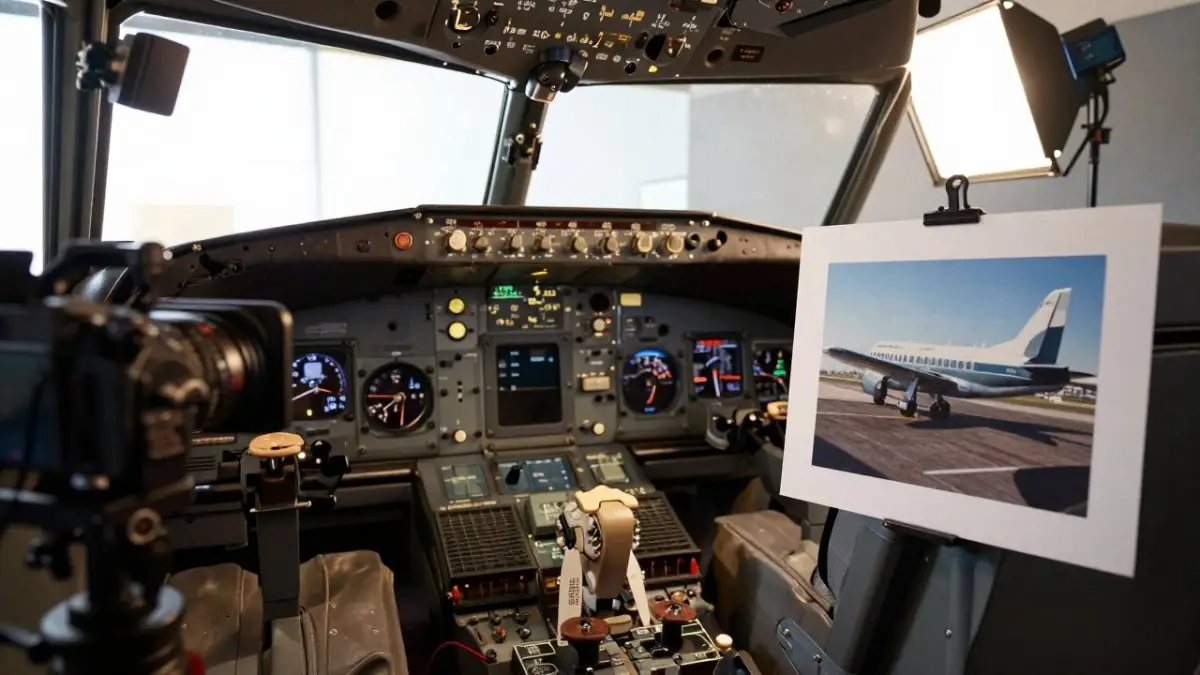
Realistic cockpit scenes in movies are rare, and the reason is partly technical. A real flight deck is a study in quiet coordination: two pilots, a stack of checklists, and radio calls that follow a strict script. Films rarely show this because it does not look like drama.
Radio communication is where accuracy slips most often. Real calls are short, standardized, and read back for confirmation. A pilot says the callsign, the instruction, and confirms it. For example, a clearance might be phrased as a short instruction followed by a read-back, and the controller expects to hear the same words returned. On screen, pilots bark improvised lines, ignore read-backs, and talk over each other. Any real crew would wince.
Pilot actions follow the same pattern. Before takeoff, crews run flow patterns and checklists. In the air, they monitor systems and communicate with air traffic control in a rhythm built on repetition. The drama is in the discipline, not the shouting. Crew coordination matters because one pilot flies while the other monitors, and they cross-check each other. When a film shows a single hero doing everything alone, it removes the very human factors, such as workload management and cross-checking, that keep real flights safe.
Watch out: the most common film shortcut is to have a pilot solve a problem by inspiration in the moment. In reality, the solution is usually a checklist, a callout, and a confirmation, and the skill is in executing it under pressure. That discipline is exactly what we try to capture in our firsthand accounts, because it is the part Hollywood leaves on the cutting room floor.
Fighter Pilot Movies Realism: Maneuvers, G-Forces, and Cockpit Culture
Fighter pilot movies realism usually gets the maneuvers roughly right and the culture almost entirely wrong. The turns, the climbs, and the formation work can look convincing. The people in the cockpit rarely do.
G-forces are a good test. Real pilots train for sustained G-loading, wear G-suits, and use a breathing and muscle-tensing technique to keep blood flowing to the brain. On screen, a pilot pulls a hard turn and delivers a full sentence. In reality, talking under high G is difficult, and the body pays a price.
Cockpit culture is the bigger gap. Films favor mavericks who ignore orders and win anyway. Real squadrons run on briefing, debriefing, and trust. The best pilots are disciplined, not reckless. For readers who want the leadership side of that culture, our leadership lessons from fighter pilots for business teams draw the practical parallels for managers and teams.
Why Accuracy Loses to Storytelling: The Filmmaking Trade-Off
Accuracy loses to storytelling because films are built around conflict, and real aviation is built around preventing it. That is the honest trade-off, and it is worth understanding before you judge a film too harshly.
A technically perfect flight scene is a checklist. A cinematic flight scene needs a problem, a reaction, and a resolution inside a few minutes. Filmmakers compress, exaggerate, and invent because the alternative is a documentary.
For readers who want the deeper story of what happens beyond the roar of engines, our book Beyond the Roar of Engines explores the reality that the camera usually misses. The trade-off is real, but so is the cost: when films get aviation wrong, audiences inherit a picture of the cockpit that no pilot would recognize.
Get the Real Story: Read Firsthand Navy Fighter Pilot Accounts
Firsthand accounts close the gap that film cannot. If you want the real story behind the legend, start with the untold grit behind America’s top gun story. For the full picture of how the movies shaped the myth, read Top Gun Hollywood. And for one pilot’s own path into the cockpit, From Dreams to Top Gun tells it directly.
Frank S. Hecker writes these accounts from the inside: the discipline, the checklists, the culture, and the courage under pressure that no two-hour film can fully capture. If you have ever watched a cockpit scene and thought, “that can’t be right,” these books are for you.
Hollywood will keep bending aviation for the sake of a story, and that is fine as long as you know where the line is. If you want the version that holds up, FRANK S HECKER delivers firsthand Navy fighter pilot accounts built on discipline, purpose, and the reality of courage under pressure. Explore the books and see the cockpit the way the crews actually lived it. Get started with FRANK S HECKER and read the story Hollywood never tells.
Frequently Asked Questions
What do movies usually get wrong about aviation?
Movies routinely get stowaways, turbulence, engine failures, and cockpit procedures wrong. Landing gear stowaways would not survive the cold and lack of oxygen at altitude. Turbulence is rarely as violent as shown. Engine failures are survivable and follow checklists. Pilots communicate with concise standard phraseology, not dramatic dialogue. These errors persist because filmmakers prioritize story and spectacle over technical accuracy.
How realistic are cockpit scenes in movies?
Most cockpit scenes are not realistic. Real flight decks are quiet and procedural, with pilots following checklists and standard radio calls. Movies add shouting, constant alarms, and hands-on controls that don’t match modern glass cockpits. Some films use technical consultants and flight simulators to improve accuracy, but dramatic license usually wins. A real pilot can spot wrong switch positions, incorrect radio calls, and impossible aircraft behavior within seconds.
Do pilots really talk and act like they do in films?
No. Real pilots use disciplined, concise communication with standard phraseology. They do not shout over alarms or make dramatic speeches. Crew resource management means clear, calm coordination. In fighter aviation, briefs and debriefs are methodical, and cockpit culture values precision over bravado. Hollywood compresses and dramatizes this for entertainment, but the real thing is quieter, more procedural, and often more impressive because of it.
Why do filmmakers change aviation details for dramatic effect?
Filmmakers change aviation details because accuracy can slow a scene or confuse audiences. A realistic engine failure involves checklists and calm coordination, not explosions. Real radio calls are clipped and repetitive. Dramatic license heightens tension, simplifies procedures, and creates visual spectacle. Production costs and audience expectations also push toward exaggeration. The result entertains, but it leaves viewers with a distorted picture of how aviation actually works.
