Quick Summary
Fighter pilots lead well under real stakes through routine discipline: they brief before every flight, state the objective aloud, and agree on who makes which call. They also set decision thresholds in advance, cross-check information across sources, and run structured debriefs that focus on process rather than blame.
- Brief before every flight, state the objective aloud, and agree on who makes which call.
- Agree on decision triggers before a project starts, such as the sales figure that prompts a pricing review.
- Triangulate important signals across at least three independent sources before acting.
- Run a debrief with fixed steps: restate the objective, describe what happened, identify the cause, agree changes.
- Run a short debrief after each significant project and a monthly review looking for recurring patterns.
Table of Contents
- What Fighter Pilots Teach About Leadership Under Real Stakes
- Decision-Making Under Pressure: Acting Without Full Information
- Situational Awareness in Leadership: Knowing What Is Happening Now
- Accountability and Debriefing: Owning Mistakes Without Blame
- Applying Leadership Lessons for Business Teams and Their Limits
- Start Your Own Debrief Next Week With Your Team
- Frequently Asked Questions
What Fighter Pilots Teach About Leadership Under Real Stakes
Last Updated: November 14, 2026
Fighter pilots operate in an environment where a wrong call can cost an aircraft or a life, which makes their approach to leadership worth studying for anyone managing a team. Frank S. Hecker’s firsthand account of life as an elite Navy fighter pilot, stripping away the polish of Hollywood dramatizations, offers a grounded look at how discipline and purpose shape performance when the stakes are real. Explore the companion piece on lessons from the sky for more on what the cockpit teaches about leadership. Many business leaders assume that high-stakes leadership is a separate skill set. The cockpit suggests otherwise: the same habits of clarity, preparation, and honest review apply on a shipping floor or in a software team.
The useful lessons are less about bravado and more about routine. Pilots brief before every flight, state the objective out loud, and agree on who makes which call. That discipline reduces confusion when conditions change, which they always do.
Consider the core principle: a clear mission objective. A pilot who knows exactly what the flight must accomplish can make fast decisions without second-guessing. Teams work the same way. When the goal is vague, every decision becomes a debate.
Decision-Making Under Pressure: Acting Without Full Information
Most leaders wait for complete information before acting. Fighter pilots cannot. They must commit to a decision with partial data, then adjust as new information arrives. The skill lies in knowing which information matters now and which can wait.
!Fighter pilot in flight suit and helmet seated in a jet cockpit, focused on instrument displays
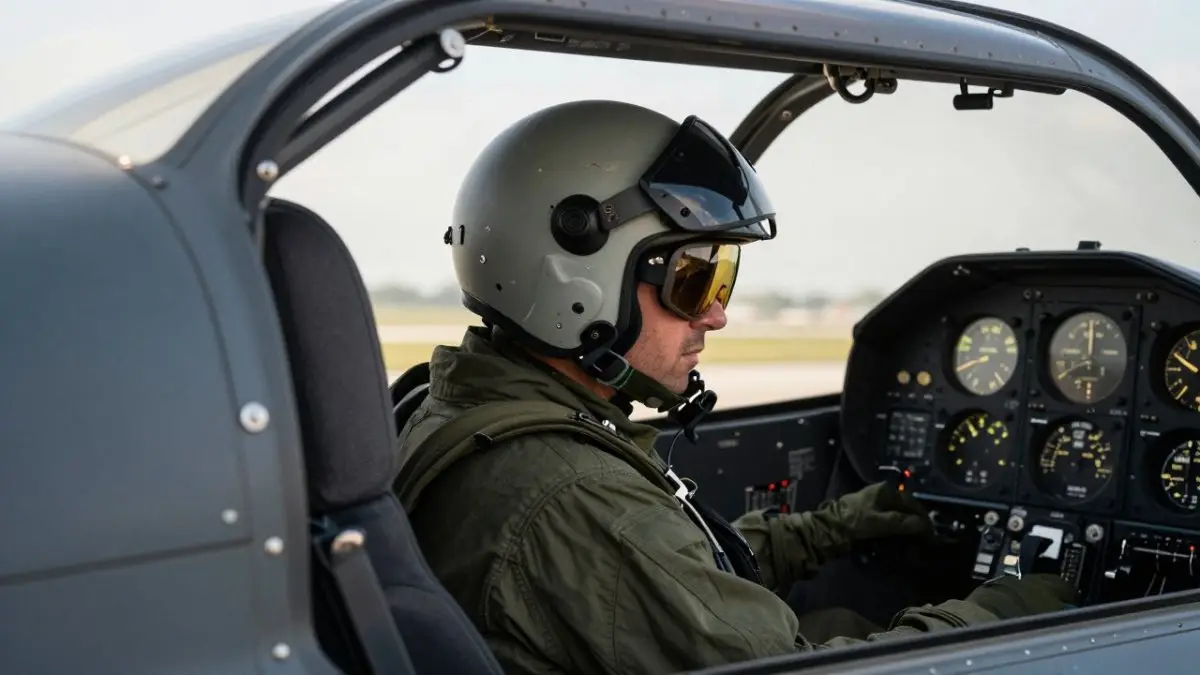
Decisive action with incomplete information requires a specific mindset. Pilots set decision thresholds in advance, so they know what evidence will trigger a change of plan. Read more on the composure and focus behind high-stakes flying to see how this plays out in the cockpit. Managers can borrow this by agreeing on triggers before a project starts, such as the sales figure that prompts a pricing review.
A common mistake is treating every decision as equally urgent. Pilots separate the time-critical calls from the ones that can be revisited. That separation keeps teams from freezing over minor choices.
Situational Awareness in Leadership: Knowing What Is Happening Now
Situational awareness means keeping an accurate picture of the environment and how it is changing. In the air, that picture comes from instruments, radio calls, and the position of other aircraft. In business, it comes from sales data, customer feedback, and the conversations people have in hallways.
Leaders often mistake a dashboard for awareness. The number on a screen shows what happened, not why. Pilots build awareness by cross-checking sources and asking teammates what they are seeing, which surfaces problems before they become emergencies.
A more useful model comes from the aviation safety community, which separates situational awareness into three levels: perception (what is happening), comprehension (what it means), and projection (what is likely to happen next). Many leadership teams stop at perception, collecting metrics and reports without agreeing on what the data means. One simple habit is to end each weekly review with two questions: ‘What does this tell us?’ and ‘What would we expect to see next if that interpretation is right?’ That second question pushes a team toward projection.
Pilots also use a technique called cross-checking, where no single instrument is trusted alone. In practice, that means triangulating a signal across at least three independent sources before acting. A sales dip, for example, might be confirmed by customer support tickets, churn data, and direct conversations with account managers.
Another transferable habit is the ‘sterile cockpit’ concept. During critical phases of flight, pilots restrict non-essential conversation so that attention stays on the task. Teams can borrow a lighter version: designate short windows in a project, such as a launch week or a major client delivery, when meetings are trimmed and status updates are consolidated.
Watch out: situational awareness degrades quietly. A team can feel informed while working from stale assumptions, so build in a scheduled ‘reality check’ where someone is explicitly tasked with challenging the current picture rather than confirming it.
Accountability and Debriefing: Owning Mistakes Without Blame
Military aviation units commonly run debriefs after flights. The purpose is to find what went wrong and why, without assigning blame to the person who made the error.
A complete debrief follows a fixed sequence that keeps the conversation on process rather than personality. Discipline standards behind honest self-review are covered in depth in this book on discipline. First, restate the objective as it was understood before the event. Second, describe what actually happened, using evidence rather than memory where possible. Third, identify the cause of each gap between plan and outcome, distinguishing between decision errors, execution errors, and information errors. Fourth, agree on one or two specific changes for the next cycle, with an owner and a date. Fifth, record the changes somewhere the team will see them again, because a debrief that produces no visible follow-through teaches people that the exercise is theater.
The most common failure is skipping the ‘why’ step. Teams describe what happened and jump straight to fixes, which means they treat symptoms. A useful discipline is to ask ‘why’ enough times to reach a systemic cause, but to stop before the conversation becomes a hunt for a culprit.
Accountability works best when it is separated from punishment. In aviation, the goal of an investigation is to prevent recurrence, not to assign fault, and that separation is what keeps people reporting hazards early (The Postal History of ICAO).
A practical cadence helps. Run a short debrief after each significant project or incident, and a longer monthly review that looks for patterns across several debriefs. The pattern view is where the real learning sits: a single error is an event, but the same error three times is a system problem.
Watch out: if the first debrief turns into a blame session, stop and reset the ground rules before continuing. A debrief that punishes people will teach the team to hide problems, which is the opposite of what the practice is for.
The article breaks a complete debrief into a fixed sequence of steps, each with a clear purpose.
| Step | What to do | Purpose |
|---|---|---|
| Restate the objective | Describe the objective as it was understood before the event | Set a shared baseline |
| Describe what happened | Use evidence rather than memory where possible | Establish facts |
| Identify the cause | Distinguish decision, execution and information errors | Find why the gap arose |
| Agree on changes | Pick one or two changes, each with an owner and date | Commit to specific action |
| Record the changes | Store them where the team will see them again | Ensure follow-through |
| Review patterns | Run a longer monthly review across several debriefs | Spot systemic problems |
Applying Leadership Lessons for Business Teams and Their Limits
Military aviation models translate to business more easily than many people expect, particularly around clarity, briefing, and debriefing. Yet the transfer has limits. A fighter squadron operates under a clear chain of command and rigid training standards. Most companies have neither, and forcing a military structure onto a creative or customer-facing team can suppress the very input leaders need.
Psychological safety matters here. A pilot may be expected to speak up about a hazard, but a junior employee in a workplace may fear that speaking up will cost them. Inclusive teams, where people from different backgrounds feel free to raise concerns, need deliberate design beyond what a cockpit culture provides.
Start Your Own Debrief Next Week With Your Team
Pick one project that finished recently and run a 30-minute review. Ask three questions: what did we plan, what actually happened, and what one change will we make next time? Keep the conversation on the process, not on individuals.
Watch out: if the first debrief turns into a blame session, stop and reset the ground rules before continuing. A debrief that punishes people will teach the team to hide problems.
Start small, repeat the exercise each month, and track whether the same mistakes keep appearing. The pattern of recurring errors tells you more than any single review.
Get the full picture of how elite aviators think about discipline and courage under pressure. Explore the books by Frank S. Hecker to read the unfiltered stories behind the lessons.
Frequently Asked Questions
What can business leaders learn from fighter pilots?
Fighter pilots operate under time pressure, incomplete information and high consequences, which forces clarity about objectives and decision authority. Business leaders can borrow the habit of stating a clear intent, pushing decisions to the people closest to the work, and running structured debriefs after every significant project. The lessons transfer best when leaders adapt them to their own risk levels rather than copying cockpit routines directly. The memoirs by Frank S. Hecker describe these habits from firsthand experience rather than dramatized accounts.
How do fighter pilots make decisions under pressure?
Pilots rely on rehearsed procedures, a shared picture of the mission and short, clear communication to decide quickly when conditions change. They accept that not every fact will be known, act on the best available information, and reassess as new data arrives. Decision authority is usually pushed to the flight member closest to the threat, which keeps responses fast. Leaders in other fields can mirror this by defining in advance who decides what when pressure rises.
What does situational awareness mean in leadership?
Situational awareness means continuously knowing what is happening around you, what is likely to happen next and what the consequences of your current choices are. Fighter pilots build it through constant scanning, briefings and updates from wingmen. Leaders build the same thing by asking frontline staff what they are seeing, watching early warning signals and avoiding reliance on a single report. Without it, decisions are based on outdated pictures of the situation.
Are the leadership lessons from fighter pilots useful outside the military?
Many principles, including clear intent, shared accountability and honest debriefing, apply to civilian teams. However, the stakes, hierarchy and speed of decisions in a cockpit differ from most workplaces, so copying military routines without adjustment can backfire. Psychological safety and inclusive participation also need deliberate attention in civilian teams, where people may hesitate to speak up. Treat the lessons as a starting framework and test each one against your own context.
