Last Updated: November 24, 2026
Quick Summary
Authentic accounts of 1970s Navy service are personal narratives written or recorded by the people who lived them, verifiable against official records and free of Hollywood embellishment. Authenticity is best judged as a paper trail: names, dates, hull numbers, and deck logs that let a reader check a story against the archive.
- Real accounts name the ship, the hull number, the deployment, and the watch.
- Deck logs record position, weather, arrivals and departures watch by watch.
- A Gearing-class destroyer carried roughly 275-350 officers and enlisted.
- The dog watches split 1600-2000 into two halves so the rotation shifted daily.
- A flight logbook records every flight, aircraft, and landing for aviators.
Table of Contents
- What Makes 1970s Navy Firsthand Accounts Authentic
- U.S. Navy Deck Logs 1970s: The Paper Trail Behind Every Sea Story
- U.S. Navy Destroyer Life 1970: Routine, Duty, and the Long Watch
- 1970s Navy Firsthand Accounts: Voices from the Fleet
- 1970s Naval Aviation History: From the Cockpit to the Carrier Deck
- Start Reading Authentic 1970s Navy Accounts Today
- Frequently Asked Questions
What Makes 1970s Navy Firsthand Accounts Authentic
Authentic accounts of 1970s Navy service are personal narratives written or recorded by the people who lived them, verifiable against official records and free of Hollywood embellishment. Authenticity is best judged as a paper trail: names, dates, hull numbers, and deck logs that let a reader check a story against the archive.
The decade itself explains why these records matter. The 1970s were a turning point for the U.S. Navy: Vietnam-era deployments wound down, the fleet shrank, budgets tightened, and a retention crisis pulled experienced sailors out of the service. Personal accounts from that stretch capture something official histories often flatten, the daily texture of shipboard life as the institution changed around the men living it.
So how do you tell a genuine memoir from a dramatized one? A few markers can help separate them:
- Specificity of place and time. Real accounts name the ship, the hull number, the deployment, and the watch.
- Cross-checkable detail. Events can be matched against Naval History and Heritage Command records and ship histories.
- Unflattering honesty. Authentic stories include boredom, mistakes, and mundane routine, not only action.
- A clear author. The reader can identify who is speaking and why they were there.
If you have wondered whether a military memoir is genuinely the author’s own or a ghostwritten invention, that question deserves a direct answer rather than a marketing one. We explain exactly how provenance works in Is a Military Memoir Ghostwritten Truth or Fiction, which walks through how to judge a firsthand account on its evidence.
U.S. Navy Deck Logs 1970s: The Paper Trail Behind Every Sea Story
U.S. Navy deck logs from the 1970s are the official, chronological record kept on the bridge of every commissioned vessel, noting position, weather, arrivals and departures, and notable events watch by watch. They are the single best tool a reader has for testing a sea story against the record.
Here is how a reader can use them to verify an account:
- Note the ship name, hull number, and dates mentioned in the story
- Pull the corresponding deck log entries for those dates
- Compare the recorded position and events with the narrative
- Check the command history for deployment and port-call confirmation
- Look for the sailor’s name in muster or personnel records where available
The National Archives holdings of Navy deck logs make many of these records accessible to researchers, and the process is more straightforward than most readers expect. A story that survives this check earns trust. A story that avoids it usually has a reason.
U.S. Navy Destroyer Life 1970: Routine, Duty, and the Long Watch
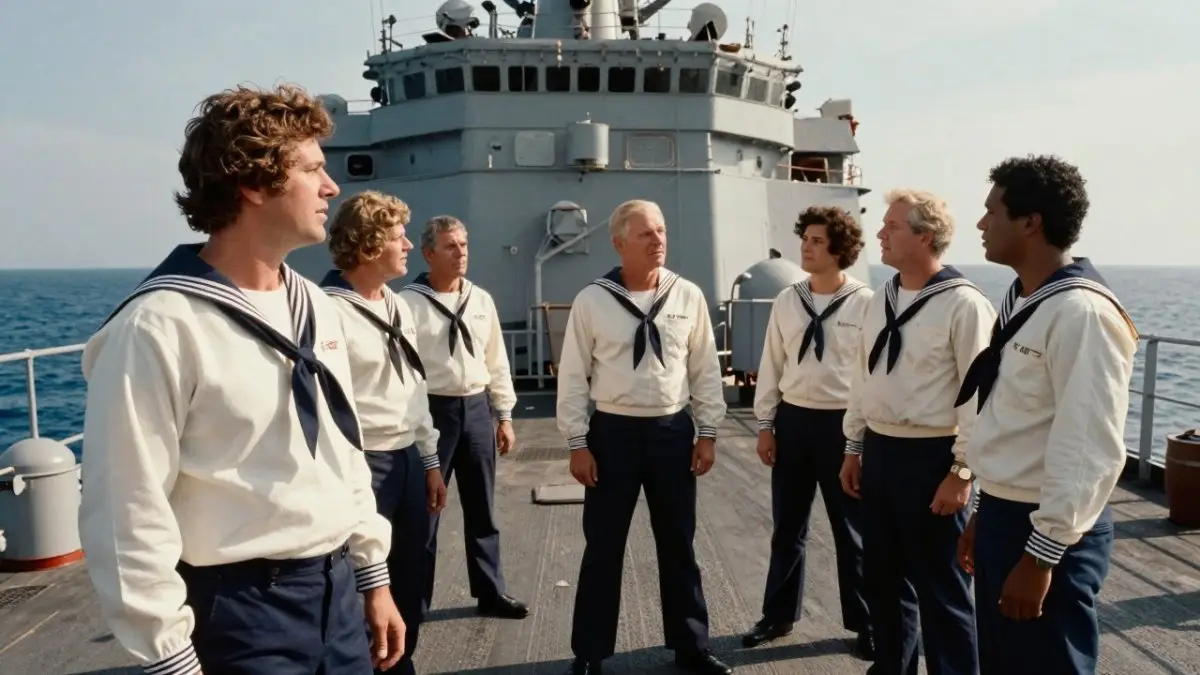
Destroyer life in 1970 meant a small ship, a tight crew, and a rhythm set entirely by the watch bill.
The watch bill divided the day into four-hour blocks: 0000-0400 midwatch, 0400-0800 morning watch, 0800-1200 forenoon, 1200-1600 afternoon, 1600-2000 dog watches (split into two two-hour halves so the rotation shifted daily), and 2000-2400 first watch. A sailor stood his station, bridge lookout, helm, engineering space, CIC, or radio, then had eight hours off for meals, maintenance, sleep, and drills before returning. The dog watches are the detail most retellings miss: splitting 1600-2000 into 1600-1800 and 1800-2000 rotated the watch schedule so no one stood the same watch every day, a small piece of Navy arithmetic that shaped every sailor’s sleep for years.
A common mistake in retellings is to compress destroyer service into combat and crisis. In practice, most of a deployment was ordinary: chipping rust and repainting the weather decks, standing watch, writing letters, and waiting.
The long watch also shaped the culture. Crews became close because there was no distance to keep, and the chief petty officer’s mess functioned as the ship’s institutional memory. Families ashore lived on deployment schedules and mail that arrived weeks late.
A memoir that describes a destroyer sailor standing the same watch every day, or a Gearing-class ship with a crew of thousands, would be worth checking against the deck log and the ship’s manning records.
Comparing ranks and rates is one of the angles most collections skip. A chief machinist’s mate in the engineering spaces and a bridge ensign on the same Adams-class destroyer in 1972 describe two different navies, and both are true.
1970s Navy Firsthand Accounts: Voices from the Fleet
The strongest 1970s Navy firsthand accounts come from across the fleet, not just the cockpit or the bridge. Enlisted sailors, junior officers, engineers, and aviators each saw the same decade through a different porthole, and comparing their voices is where the real history sits.
A useful way to organize what you read:
| Perspective | What they saw clearly | What they often missed |
|---|---|---|
| Enlisted sailor | Watch routine, mess deck life, crew bonds | Strategy and higher command decisions |
| Junior officer | Division leadership, daily pressure | The view from the top |
| Engineer | Propulsion, damage control, readiness | Flight operations and air wing culture |
| Aviator | Cockpit workload, carrier cycles | Shipboard routine below decks |
Experiences beyond Vietnam matter here too. Not every 1970s deployment was a combat cruise; many were Mediterranean, Atlantic, or Western Pacific rotations that shaped sailors just as deeply. An account that only covers combat leaves most of the decade on the table.
1970s Naval Aviation History: From the Cockpit to the Carrier Deck
Naval aviation in the 1970s was a discipline of repetition and precision, flown by men who spent far more time training and drilling than fighting.
Carrier operations ran on a cycle measured in seconds. The catapult shot, the approach, and the arrested landing were rehearsed hundreds of times before a deployment, and the margin between a good landing and a bad one was small enough that aircrew treated every pass as serious. The landing signal officer (LSO) graded every pass, and those grades, cut, fair, no-grade, followed a pilot through his career.
The decade also connects aviation to the wider fleet story. Force levels and readiness shaped how often squadrons deployed, and personnel shortages meant experienced aviators carried heavier loads. A pilot’s memoir from that era is also a document about the Navy’s manpower problem, whether the author intended it or not.
Provenance is worth checking. A naval aviator’s account can be checked against his flight logbook, his squadron’s cruise book, the carrier’s deck log, and the air wing’s command history. The flight logbook records every flight, every aircraft, and every landing, it is the aviation equivalent of the deck log, and it is the single best tool a reader has for testing a cockpit story against the record.
For readers drawn to naval aviation stories, the related carrier and fighter-pilot accounts in Best of the Best – TOP GUN Hollywood-hc extend that picture, contrasting the dramatized version with the grounded one.
Start Reading Authentic 1970s Navy Accounts Today
Firsthand accounts written by the people who stood the watches offer a grounded view of Navy life. If you want that firsthand version, from the cockpit to the carrier deck, that is the focus of the books on this site.
You can start with the ebook if you read digitally, the Best of the Best paperback if you prefer a physical copy on the shelf, or the audiobook if you would rather listen to the accounts told aloud.
Authentic accounts of 1970s Navy service reward readers who check the record rather than take a story at face value. At FRANK S HECKER, our books deliver a grounded, firsthand perspective on elite fighter-pilot life, the discipline behind it, and the courage required under pressure, with the Hollywood artifice stripped away. Get started with FRANK S HECKER and read the decade as the men who lived it actually told it.
Frequently Asked Questions
How do I find my father’s Navy service records from the 1970s?
Start with a request to the National Personnel Records Center using Standard Form 180. Provide as much detail as you have: full name, service number, and approximate dates. For deck logs, search the National Archives catalog by ship name and year. Many 1970s Navy records are available on microfilm or digitized. If you hit a wall, veterans’ organizations and naval history associations can point you to additional sources.
Where can I find firsthand accounts of U.S. Navy life in the 1970s?
Look for published memoirs by veterans who served in that decade, oral history collections at the Naval War College and Library of Congress, and unit association newsletters. Books like Frank S. Hecker’s fighter pilot memoir offer a grounded, non-dramatized view of 1970s naval aviation. Deck logs and cruise books add context. Cross-checking multiple 1970s Navy firsthand accounts helps separate memory from fact.
How can I verify a Navy sea story from the 1970s?
Compare the story against deck logs, which record a ship’s position, events, and daily routine. Check squadron or ship histories, cruise books, and after-action reports. If the account involves aviation, look for flight schedules or incident reports. Oral histories from other crew members can confirm or contradict details. No single source is perfect, but matching three or four independent records gives you a reliable picture.
What was life aboard a U.S. Navy destroyer like in 1970?
Destroyer life in 1970 meant tight quarters, long watches, and constant drills. Crews typically stood four-hour watches, maintained equipment, and stood ready for deployment. The ship was small enough that everyone knew each other’s job. Port visits offered brief breaks, but the routine was disciplined and repetitive. Firsthand accounts from that era describe a demanding environment where teamwork and improvisation kept the ship running.
